


Yet, many homeowners, designers, and renovators struggle with a common question: “How do I choose the right size of pendant light?” At Jaquar, we believe lighting should deliver both form and function.
In this guide, we break that question down into clear, practical steps, with measurements, formulas, and room-by-room recommendations, so you can light your space effectively and stylishly.
Why Pendant Light Size Matters
Choosing the right size for a pendant light involves more than simply fitting it into the space. The size affects:
- How well the light illuminates a surface
- How balanced the lighting feels with furniture and architecture
- Visual proportion and design harmony
- The room’s ambience and scale perception
A pendant that is too large can overwhelm a space, and a light that is too small becomes invisible and loses impact. Similarly, incorrect hanging height or diameter can cause glare or shadows.
The goal is to choose a pendant light size that complements your space’s scale, enhances usability, and highlights the design.
Core Principles for Choosing Pendant Light Size
We recommend using a few simple formulas and guidelines to determine the right pendant light size:
1. Consider the Room Size (Width + Length)
The basic rule of thumb for overall room lighting is:
Room width (ft) + Room length (ft) = Pendant diameter (in inches)
For example:
- A room measuring 10 ft x 12 ft → 10 + 12 = 22 inches
- This means a pendant or cluster diameter of around 22 inches is balanced for overall illumination.
This formula gives you a good starting point for the overall scale of a single fixture or a cluster.
2. For Dining Tables and Islands: Use Height & Diameter Metrics
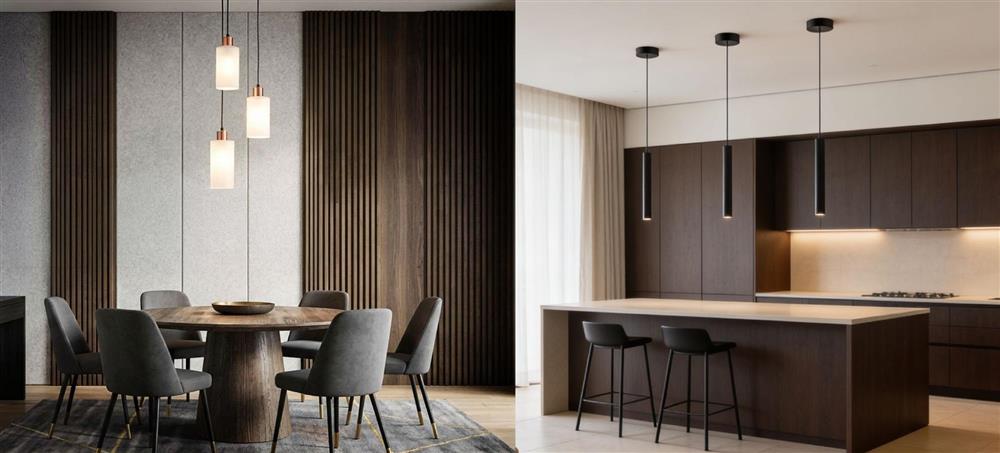
Pendant Diameter
When installing over a table or island:
Pendant Diameter = Table width (in inches) / 2 to 3
Example:
- Table width = 36 inches
- Pendant diameter = 12-18 inches
If you are using multiple pendants:
- Divide the total recommended diameter proportionally among pendants.
- Ensure spacing is aesthetically consistent (e.g., three pendants over an island).
Pendant Height
For hanging lights over surfaces:
- For a dining table: 30-36 inches above the tabletop
- For kitchen islands: 28-34 inches above the countertop
This range ensures proper task lighting while avoiding sightline obstruction or eye glare.
3. Ceiling Height Matters Too
The higher the ceiling, the larger or taller your pendant can be, but spacing and practicality still matter.
Use this guideline:
- Standard ceiling (8-9 ft): Keep pendant height so the bottom is about 30-36 inches above surfaces.
- Higher ceilings: Add 3 inches per extra foot of ceiling height.
So, for a 10-ft ceiling, you might hang pendants about:
- 36-39 inches above the table
- Taller or layered pendants work well with higher ceilings
Choosing Pendant Lights for Different Rooms
Every room has its own functional needs and scale considerations. Here’s how to choose pendant light size, room-by-room:
1. Kitchen Islands & Breakfast Bars
Kitchen islands are among the most common spaces for pendant lighting. These hanging lights offer both general and task lighting.
- Use pendants that are about 12-18 inches in diameter.
- If using multiple pendants, space them evenly and keep them proportionate to the island length.
- Hang pendants 28-34 inches above the island or countertop
Why This Works:
Good task lighting here prevents shadows while preparing food and creates a clear visual anchor for gatherings.
2. Dining Rooms
A pendant light above the dining table serves as a focal point, so its size and height are crucial.
- Pendant diameter should be about half to two-thirds the table width.
- For long tables, use multiple types of pendant lights or a larger single statement piece.
- The ideal height should be 30-36 inches above the tabletop.
This range avoids glare while providing ample illumination for meals and conversation.
3. Entryways & Foyers
Entry spaces often have taller ceilings, so striking pendants can create dramatic impressions.
- For double-height spaces, pendants can be larger and proportionate to height.
- Use cascading or longer drop pendants.
- A general guideline is to ensure pendants hang within 7 feet of floor level in two-storey spaces.
Pendant lights with an artistic touch can enhance the entry’s ambience while providing practical lighting.
4. Living Rooms and Lounges
Living areas are versatile in use, so pendant lights should be chosen carefully to work with other luminaires.
- Use a diameter that complements seating arrangements.
- Avoid overpowering a low ceiling with large pendants.
- Keep pendants at least 7 feet above the floor for walking areas.
- Lower hang heights can be used above seating clusters if scale permits.
5. Bathrooms and Vanities
Bathrooms, especially over vanities, require precise sizing.
- Choose slimmer or smaller pendants to avoid overwhelming the mirror area.
- Pendant lights with diffused illumination work well.
- Height should be around 30-36 inches above the countertop.
- Ensure placement doesn’t interfere with mirror reflection or eye-level glare.
Other Considerations When Choosing Pendant Lights
Here are some other key factors to consider when choosing pendant lighting:
1. Light Output and Colour Temperature
Every pendant light has a specific lumen output and colour temperature. Warm white (2700-3000K) gives a cosy ambience; neutral or cool white is better for task areas.
2. Beam Spread and Diffusers
Some pendant lights offer diffusers or downward illumination. Pendant lights are a popular choice when you want both functional light and decorative appeal.
3. Fixture Shape and Design
Pendant lights come in many shapes, including cylindrical, globe, conical, disc, clustered, and sculptural. Shape influences how light spreads and how the fixture integrates with interiors.
4. Number of Pendants
Multiple smaller pendant lights can create layered lighting effects, while a single large pendant becomes a design statement.
5. Style and Interiors
Consider the room’s architectural style. Contemporary interiors may favour sleek linear pendant lights. Classic or traditional spaces may use ornate and a range of modern pendant lights.
Why Jaquar Pendant Lights are a Great Choice
Choosing the right pendant light size for any room needn’t be complicated. By understanding room dimensions, ceiling height, surface areas, and design intent, you can select lighting that balances form and function.
Use the practical formulas and room-by-room guidelines in this guide to inform your choices and explore Jaquar’s range of pendant and hanging lights for solutions that are both beautiful and technically sound. We design pendant lights to meet both technical performance and aesthetic needs. Whether you seek functional task lighting, ambient illumination, or a striking design feature, our range includes options that blend seamlessly with modern interiors.
From elegant pendant lights to sleek contemporary designs, we offer solutions that enhance your space while delivering superior lighting.
FAQs
For most kitchens, pendant lights should hang 28-34 inches above the island to provide effective task lighting without blocking sightlines.
Yes, using multiple evenly spaced pendants is ideal for long tables, ensuring balanced illumination and visual symmetry.
While there is no single number, a good rule is to keep the pendant’s diameter proportional to seating areas.
Warm white (2700-3000K) creates a cosy ambience, ideal for living and dining areas. Cool white (3500-5000K) is better for task areas like kitchens and workspaces.
Absolutely, high ceilings allow for larger or longer drop pendants. Follow the guideline of maintaining at least 7 feet from the floor to the bottom of the fixture to ensure functionality and comfort.
 Bath :